
⭐ “Is My Child Falling Behind? What Parents Can Do at Home”
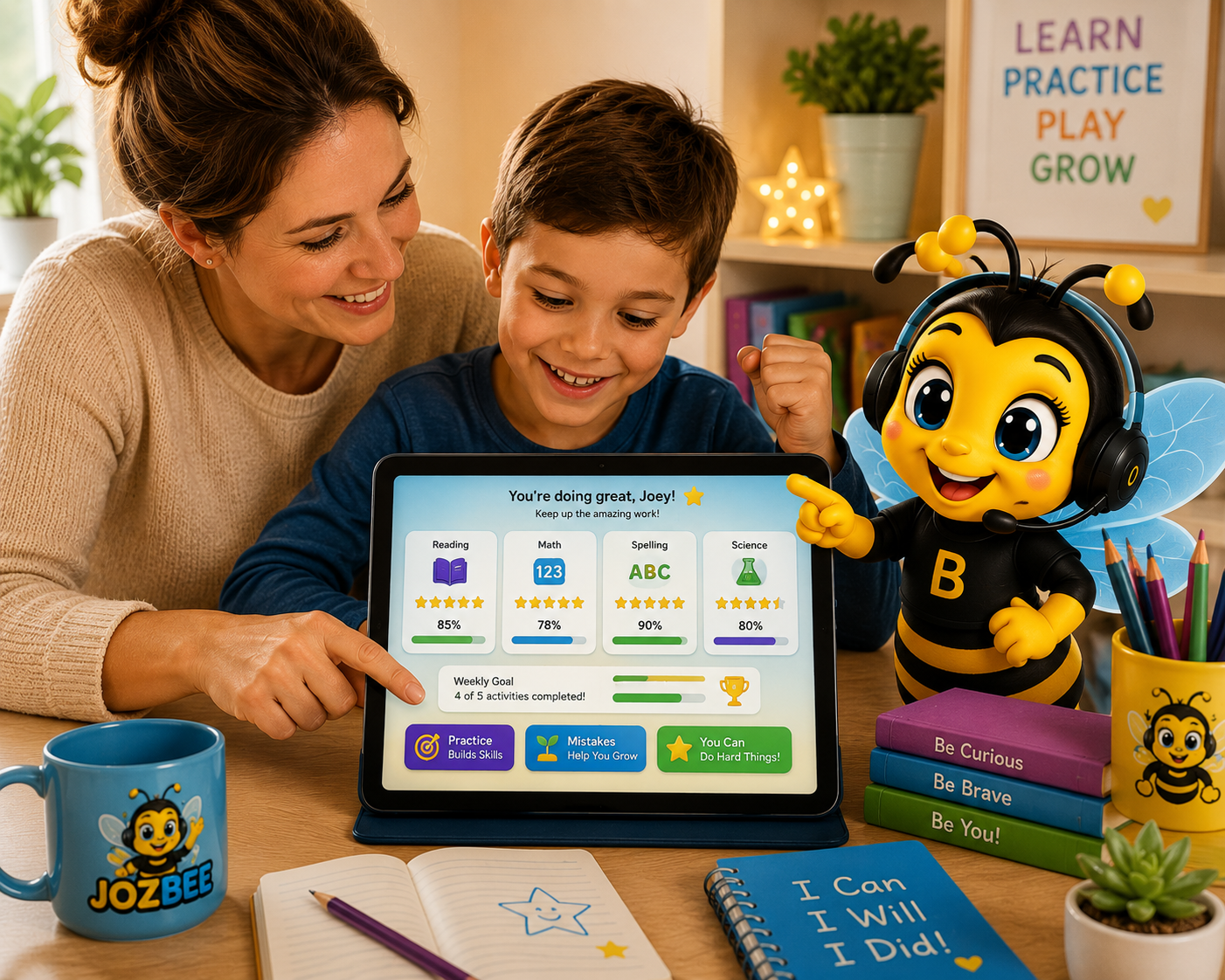
It’s a thought that can make almost any parent worry:
“Is my child falling behind?”
Maybe homework is taking longer than it used to. Maybe reading seems harder for your child than it does for classmates. Perhaps math suddenly ends in frustration, or your child has started saying things like:
“I’m just not good at this.”
Before assuming something is wrong, remember something important:
Children don’t all learn at the same speed—or in the same way.
A child struggling with a skill today doesn’t tell us what they’ll be capable of tomorrow.
Sometimes children simply need more practice, a different explanation, smaller steps, or a little more confidence.
Here are some ways you can support your child at home without turning every evening into another school day.
🐝 First: Try Not to Focus on “Keeping Up
It’s easy to compare.
Another child may already be reading chapter books. Someone else has multiplication facts memorized. A sibling may have learned the same skill much faster.
But learning isn’t a race.
Instead of asking:
“Are they where everyone else is?”
Try asking:
“Are they making progress?”
A child who moves from struggling with ten spelling words to confidently knowing six of them has made progress.
And progress deserves to be celebrated.
🔎 Look for the Skill Behind the Struggle
Sometimes what looks like one problem is actually something else.
A child struggling with a math word problem may understand the math but have trouble reading the question.
A child who avoids writing may have wonderful ideas but struggle to organize them on paper.
A child who says, “I hate reading,” may actually be frustrated because reading feels harder than they think it should.
Instead of immediately correcting the final answer, try figuring out where the difficulty begins.
Ask:
“Show me the part that feels hard.”
That one question can tell you a lot.
🪜 Break Learning Into Smaller Steps
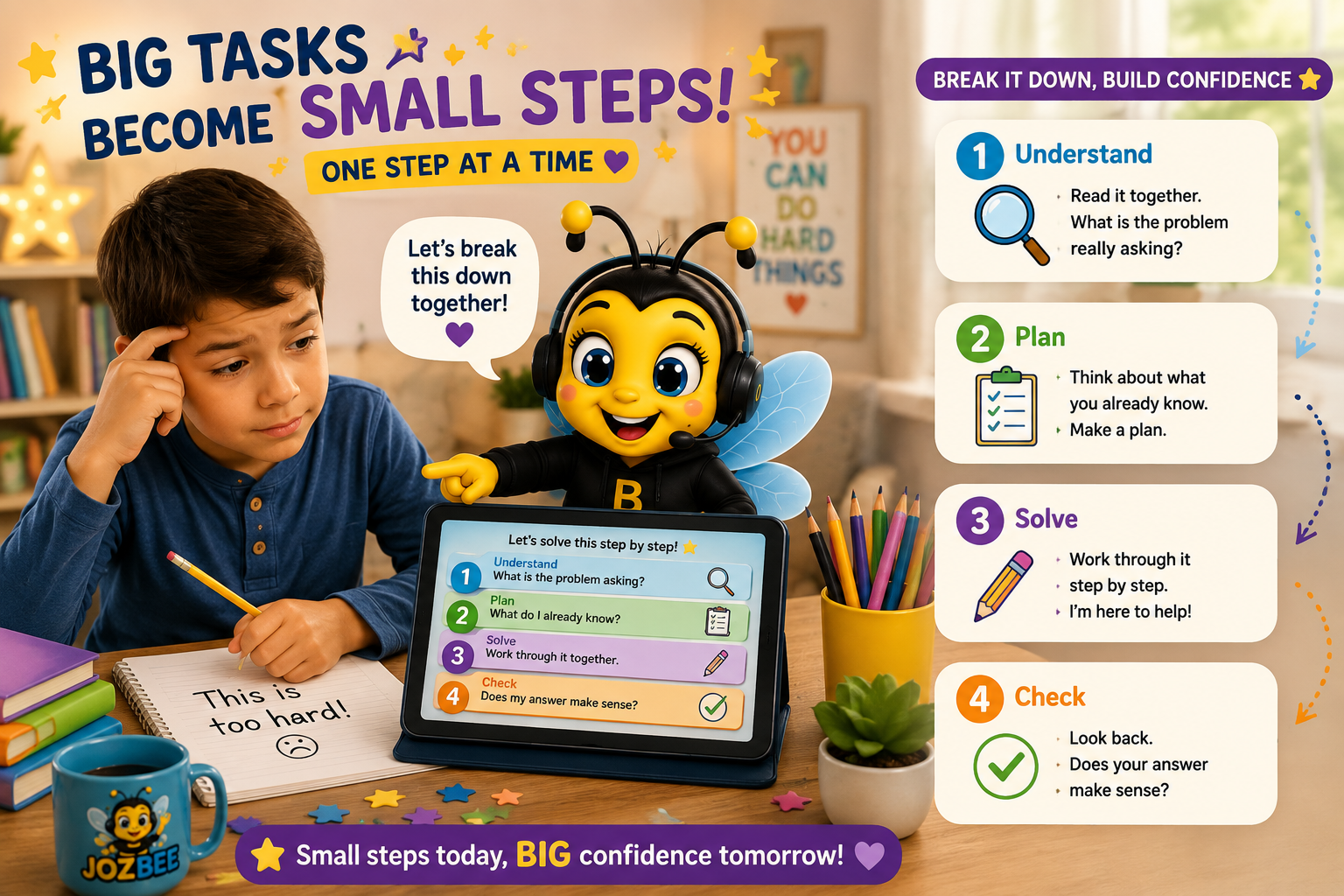
Imagine being handed something that feels impossible and being told:
“Finish all of this.”
That’s how a full worksheet or long assignment can feel to a struggling child.
Try making the goal smaller.
Instead of:
“Finish all 20 problems.”
Try:
“Let’s do the first three.”
Then celebrate the accomplishment and move forward.
Small wins help turn:
“I can't do this.”
into:
“Maybe I can.”
⏱️ Short Practice Can Be Better Than Long Practice
More isn't always better.
An exhausted, frustrated child spending an hour staring at homework isn't necessarily learning more than a child who spends 15 focused minutes practicing a skill.
For many children, shorter learning sessions with breaks can feel much more manageable.
You can even turn practice into little challenges:
“Let's see how many we can figure out together in ten minutes.”
Then stop.
Learning at home doesn't have to consume the entire evening.
🎮 Practice Without Making It Feel Like Homework
Children learn in more places than a classroom.
Practice math while cooking.
Count money at the store.
Read signs while driving.
Write a silly story.
Measure something you're building.
Play word games.
Do a science experiment.
Use educational games and interactive activities.
When children discover that reading, math, science, and problem-solving exist in the real world, learning can start to feel much more meaningful.
💡 Try Explaining It Another Way
Have you ever had someone explain something several times and still not understood it—then someone else explained it differently and suddenly it clicked?
Kids experience that too.
If your child doesn't understand an explanation, repeating the exact same explanation louder or more slowly may not help.
Try another approach.
Use pictures.
Use objects.
Draw it.
Tell a story.
Give an example.
Turn it into a game.
Break it into smaller pieces.
Sometimes the issue isn't whether a child can learn something.
It's finding the way that helps that particular child understand it.
💛 Protect Their Confidence
This may be one of the most important things parents can do.
Children notice when something seems easier for everyone else.
And eventually:
“This is hard.”
can become:
“I'm bad at this.”
Those are very different statements.
Remind your child:
“You don't know it yet.”
“We're going to figure out what works for you.”
“Making mistakes is part of learning.”
“Look how much you've already learned.”
Your child should know that needing help doesn't mean they're not smart.
🌱 Pay Attention to Progress, Not Perfection
Progress can be easy to miss.
Maybe your child reads five more words independently than they did last month.
Maybe they need fewer reminders.
Maybe homework that once caused tears now only requires a little help.
Maybe they're finally willing to attempt a difficult problem before asking for the answer.
Those are wins.
Consider occasionally showing your child their own progress:
“Remember when this was really hard for you? Look what you can do now.”
That can be incredibly powerful.
👩🏫 Stay Connected With Your Child's Teacher
If you're concerned about your child's progress, their teacher can provide valuable insight.
Ask specific questions such as:
“Which skills should we practice most at home?”
“Where are you seeing the biggest difficulty?”
“What does my child do well?”
“Are there strategies you're using at school that we can also use at home?”
Working together gives your child consistency between school and home.
And if a child is having persistent difficulty despite appropriate instruction and practice, their teacher can also help parents understand what additional school-based support or evaluation options may be available.
🤖 Where JOZBEE Fits In
This is one of the reasons we're building JOZBEE.
Children don't always need more work.
Sometimes they need better support with the work they're already doing.
JOZBEE is being designed as an interactive learning buddy that can help children practice skills, work through problems step by step, receive hints when they're stuck, hear concepts explained differently, and build confidence as they progress.
Rather than simply giving a child the answer, the goal is to keep the child involved:
“What do you think comes next?”
“Great try! Want a hint?”
“Let's break this into smaller steps.”
“You got it! Ready to try another?”
And because children have different strengths and needs, JOZBEE is being built to support different ages, subjects, and ways of learning.
📊 Helping Parents See the Wins, Too
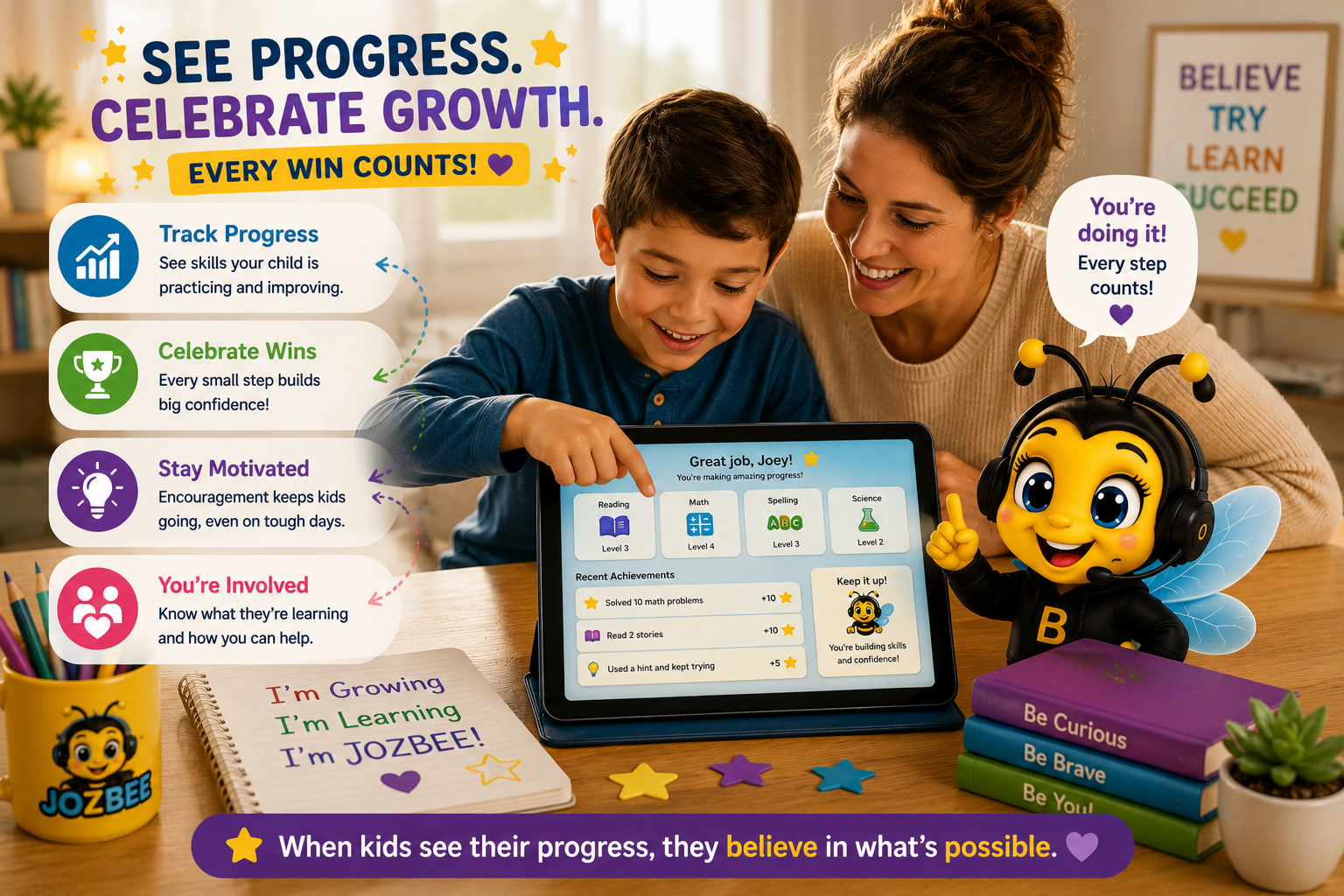
Children aren't the only ones who need encouragement.
Parents want to know:
What is my child practicing?
Where are they improving?
Where might they need more help?
That's why progress is an important part of the JOZBEE vision.
Instead of focusing only on scores, we want parents to be able to recognize growth—the skills children are practicing, the areas they're strengthening, and the accomplishments worth celebrating.
Because sometimes progress is happening even when it doesn't feel dramatic.
🐝 Your Child Is More Than a Grade
Grades and test scores can provide information, but they don't define a child.
Neither does how quickly they learned multiplication.
Or when they started reading independently.
Or whether they needed extra help with spelling.
Children are learning much more than academic skills.
They're learning how to persevere.
How to solve problems.
How to ask for help.
How to recover from mistakes.
And, hopefully, how to believe in themselves.
If your child is struggling right now, don't make the goal:
“Catch up as fast as possible.”
Make the goal:
“Let's figure out what helps you learn.”
Then take it one skill, one success, and one confident little step at a time.
